Can HR Software Integrate
With Your Existing ERP? What Businesses Need to Know
Many businesses rely on different
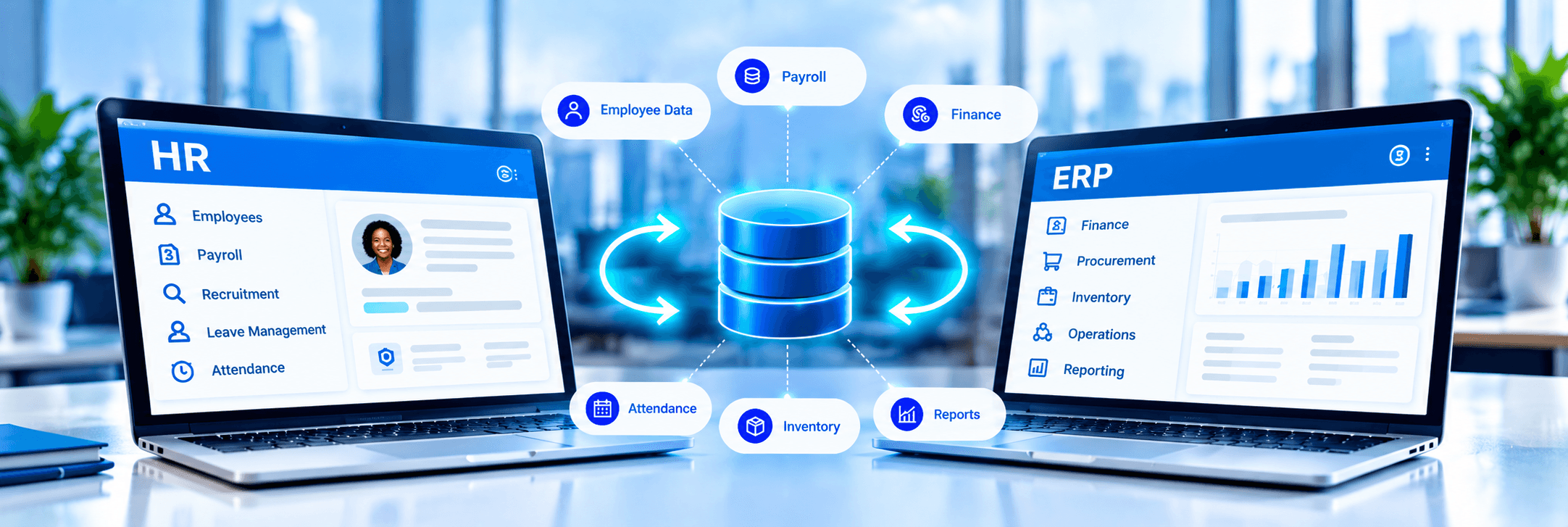
software systems to manage their daily operations. Their HR teams may use one
platform for employee records, payroll, recruitment and leave management, while
finance, procurement, and inventory teams work with a separate Enterprise
Resource Planning (ERP) system.
Although each system may serve a
specific purpose, managing them separately can create operational challenges.
Employees may have to enter the same information into multiple platforms,
departments may work with inconsistent records, and important updates may take
longer to reach the right people.
This raises an important question: Can
HR software integrate with your existing ERP system?
In many cases, yes. HR software can
connect with an ERP system to help relevant employee and business data move
between platforms. However, the feasibility and scope of integration depend on
the systems involved, their technical capabilities, and the organisation’s
specific requirements.
Understanding how integration works
can help your business make a more informed decision without unnecessarily
replacing systems it already uses.
What Does HR Software Integration With an ERP Mean?
HR software ERP integration involves
connecting a human resources platform with an organisation’s existing ERP
system so that relevant information can be exchanged between them.
An HR system typically manages
employee-related processes such as recruitment, onboarding, employee records,
payroll inputs, attendance and leave. An ERP system may support broader
business functions, including finance, procurement, inventory and other operational
processes.
When these systems are connected,
authorised information can flow between them instead of requiring employees to
transfer it manually.
For example, an employee’s department
or employment status may need to be reflected in more than one system. With an
appropriately configured integration, an approved update in one platform can be
shared with the other, depending on the agreed workflow.
Similarly, relevant payroll
information may be transferred to a finance or accounting system to support
reporting and reconciliation.
The objective is to create better
coordination between departments, reduce repetitive data entry and improve the
consistency of business information.
However, integration does not
automatically mean that every feature in both systems will work together.
Businesses need to identify which information should be shared, how the
connection will work, and which system will remain the primary source for each
type of data.
5 Things Businesses Need to Know About HR Software and ERP
Integration
Before choosing HR software that
integrates with an existing ERP, businesses should evaluate five important
considerations.
1. Compatibility With Your Existing ERP
Not every HR software platform can
connect to every ERP system in the same way.
Compatibility depends on factors such
as the software versions, available application programming interfaces (APIs),
supported integration methods, security requirements, and the specific
processes a business wants to connect.
For example, a company may want its HR
platform to share employee information with its ERP system or transfer relevant
payroll data to its finance software. Whether this is possible, and how much
configuration is required, depends on the technical capabilities of both
platforms.
Before committing to an integration,
businesses should:
● Identify the ERP system and
version currently in use.
● List the HR processes and data
that need to be connected.
● Confirm whether the systems
support suitable integration methods.
● Determine whether additional
configuration, development, or third-party tools will be required.
● Agree on the expected scope,
costs, and implementation timeline.
Evaluating compatibility early can
help prevent unexpected costs and implementation delays.
The important point is to choose an HR
solution that fits your business requirements and can work with your existing
technology environment where technically feasible.
2. Data Synchronisation and Accuracy
One of the main benefits of HR
software ERP integration is the ability to reduce repetitive data entry and
improve information consistency across departments.
When systems operate independently,
the same employee information may be recorded in multiple places. If one record
is updated but another is not, the organisation may end up with conflicting
information.
For example, an employee may transfer
to a different department. If the change is not reflected across the relevant
systems, reporting structures, departmental reports and other business
processes may rely on outdated information.
An effective integration can help
minimise these inconsistencies by enabling relevant data to be shared between
connected platforms.
However, businesses should establish
clear data management rules before implementation.
Consider the following questions:
● Which employee and business
data should be shared?
● How frequently should
information be updated?
● Which system is the primary
source of truth for each data type?
● Who is authorised to make
changes?
● How will failed updates,
duplicate records or conflicting information be handled?
These decisions help ensure that
integration improves data reliability rather than simply transferring existing
errors between systems.
3. Automation of HR and Business Processes
Integrating HR software with an ERP
can reduce manual work by connecting processes that would otherwise require
separate updates.
For example, relevant employee
information may be shared with another system after an approved update.
Payroll-related information may also be transferred to support finance
processes, while workforce and departmental data can contribute to more
consistent reporting.
Depending on the systems and agreed
integration scope, this can help businesses:
● Reduce repetitive data entry.
● Minimise administrative errors.
● Improve coordination between HR
and finance teams.
● Make relevant information
available to authorised departments sooner.
● Simplify reporting across
connected business functions.
Consider an organisation that
processes payroll using HR data but maintains financial records in a separate
ERP system. Without an integration, employees may need to export, review and
transfer information manually. A suitable integration can help streamline that
process.
The exact level of automation will
depend on the systems involved and the workflows configured.
Businesses should therefore identify
the processes that consume the most time or create the most errors before
implementation. This makes it easier to prioritise integrations that deliver
practical operational value.
4. Data Security and Access Control
Employee information often includes
sensitive personal and employment data. Connecting HR software with an ERP
system must therefore be approached with security and privacy in mind.
Integration should not mean that every
department automatically gains access to all employee information. Access
should be limited to authorised users and the specific data required for their
responsibilities.
Before implementation, businesses
should evaluate:
● Access permissions: Who can view, update, or transfer information?
● Data protection: How is information protected while being transferred and stored?
● Audit trails: Can relevant changes and activities be tracked?
● Authentication and access
controls: How are systems and users verified?
● Data minimisation: Is only the information required for the process being shared?
● Compliance: Does the proposed arrangement align with applicable data protection
requirements and the organisation’s internal policies?
Businesses should also establish how
integration errors, unauthorised access and other security incidents will be
identified and handled.
A well-planned integration should
support operational efficiency while maintaining appropriate safeguards for
employee and business information.
5. Implementation, Scalability and Ongoing
Support
Successful HR software ERP integration
requires more than connecting two platforms. It involves planning, testing,
coordination, and ongoing technical support.
Before implementation, businesses
should understand the work involved, the teams responsible, and the changes
employees may need to adopt.
Important considerations include:
● Implementation timeline: How long will the integration take?
● Data preparation: Will existing records need to be cleaned, mapped, or migrated?
● Testing: How will the business confirm that information moves accurately
between systems?
● Staff training: Will HR, finance, IT, and other relevant teams need training?
● Ongoing maintenance: Who will resolve technical issues and manage changes?
● Scalability: Can the integration accommodate additional employees, departments,
locations, or business processes?
● Support arrangements: What technical assistance will be available after implementation?
Businesses should test key workflows
before relying on an integration in live operations. Testing can help identify
missing data, incorrect field mappings, failed transfers, and permission issues
before they affect daily activities.
It is also important to confirm how
the integration will be maintained when either platform is updated.
Choosing a solution with a clear
implementation and support plan can help an organisation manage change more
effectively and adapt as its workforce and operational needs evolve.
Do You Need to Replace Your Existing ERP to Improve HR
Management?
Not necessarily.
An organisation may already have an
ERP system that supports its finance, procurement, inventory, or other business
processes. Replacing that system solely to improve HR operations may not be the
most practical option, particularly when the existing platform remains valuable
to the business.
An alternative is to evaluate whether
a dedicated HR and workforce management solution can connect with the current
ERP.
This approach may allow the
organisation to retain existing business systems while improving employee
management, payroll administration, attendance tracking, leave management and
workforce reporting through a suitable HR platform.
However, integration is not always the
right solution for every business. In some cases, the existing ERP may already
provide the required HR capabilities. In others, technical limitations or the
cost of integration may make an alternative approach more appropriate.
The decision should be based on the
organisation’s current systems, business requirements, technical feasibility,
budget, and long-term technology strategy.
How CynegieHR Can Support Your HR and ERP Integration Needs
Businesses looking to connect HR
processes with existing business systems need a solution that fits their
operational requirements rather than creating another disconnected platform.
CynegieHR provides HR and workforce
management capabilities designed to help organisations manage employee
information and coordinate important workforce processes. Depending on the
selected modules and configuration, these capabilities can support areas such
as employee records, payroll management, time and attendance, leave management,
recruitment, onboarding, employee self-service and workforce reporting.
For organisations that already use an
ERP system, CynegieHR can assess the possibility of integration with the
existing environment. The purpose is to determine how relevant workforce
information and business processes can be connected without assuming that the
organisation must replace its current systems.
The appropriate integration approach
will depend on the ERP platform, available integration methods, security
requirements and the business processes involved. Technical discovery is
therefore necessary to confirm compatibility, scope, implementation requirements
and any additional development or integration work.
Rather than treating integration as a
one-size-fits-all exercise, businesses should begin by identifying their
operational challenges and determining which processes would benefit most from
better connectivity.
Take the Next Step Towards Connected Workforce
Management
Your HR software and ERP system do not
necessarily need to operate in isolation. With the right assessment and
implementation plan, connecting relevant processes can help reduce manual work,
improve data consistency and support better coordination between departments.
If your organisation is exploring HR
software ERP integration, CynegieHR can help you assess your workforce
management needs and explore how the platform may work with your existing
business systems.
Book a CynegieHR demo to discuss
your requirements and explore a suitable approach for your organisation.